




High-throughput NaV1.9 assay to advance pain drug discovery

CONTACT US

Boost screening efficiency for pain targets with high-throughput NaV1.9 assays

Generate reproducible, decision-ready data for hit identification, hit-to-lead optimisation and translational studies using Metrion's validated human and rat NaV1.9 assays. These robust stably expressing NaV1.9 cell lines (human and rat) have been validated on the QPatch 48 and Qube 384 electrophysiology platforms enable:

  • Stable expression ensures consistent and reproducible results: Stable expression of NaV1.9 (human and rat) means assays are more reliable, supporting high-quality screening and dependable pharmacological data.
  • High-throughput, cost-efficient screening campaigns: Critical for early-stage drug discovery.
  • Expand your pain drug discovery opportunities: Our validated NaV1.9 assays make this challenging but clinically relevant target accessible for screening.
  • Improved translational relevance: Having both human and rat cell lines allows for cross-species pharmacology studies, improving translational relevance and supporting regulatory submissions down the line.

Faster, smarter, cost-effective NaV1.9 screening that will unlock ROI

With over a decade of electrophysiology expertise, the NaV1.9 assay, alongside Metrion’s unique combination of ion channel expertise, bespoke assays and pain research services, enables researchers to overcome traditional limitations of NaV1.9 screening, to generate reproducible and decision-ready data.

The business case is clear for organisations looking to rapidly meet project milestones and unlock ROI in pain drug discovery:

  • Shorter timelines: High-quality screening assays accelerate project milestones.
  • Lower costs: Reliable screening data to robustly support medicinal chemistry.
  • Cost-effective outsourcing: Rapid, expert data interpretation ensures confident advancement of promising compounds.
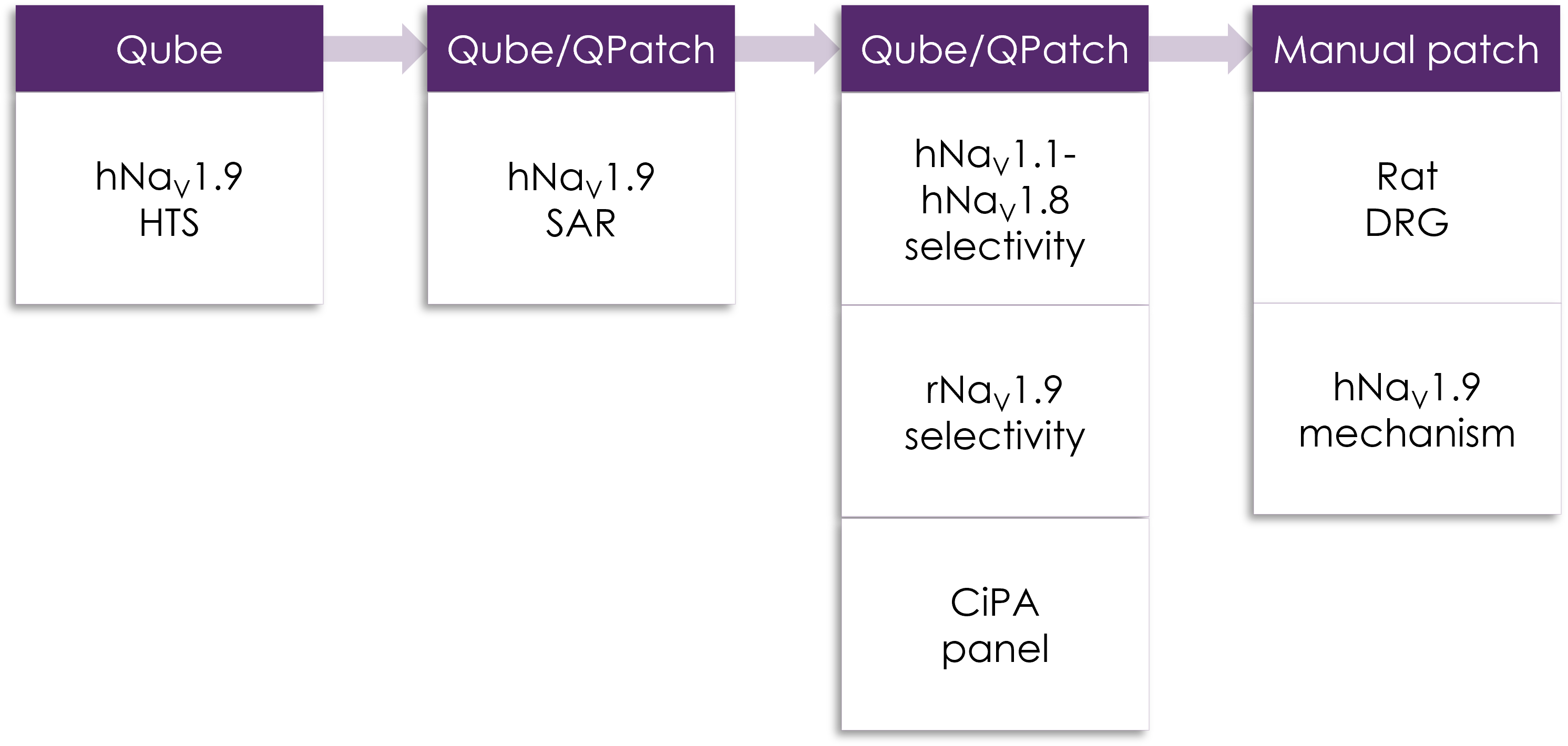
  • High confidence in NaV1.9 screening cascade (Figure 1):
    • Identify high quality hits
    • Accelerate hit-to-lead discovery
    • Investigate mechanism of action via translational assays

Figure 1. Example of Metrion's NaV1.9 screening cascade.

Apply Metrion’s expertise to your NaV1.9 research

Contact us today to learn how Metrion’s cutting-edge pain research services can help you achieve your research goals:

Let's advance your pain drug discovery together

Development of a high-throughput automated electrophysiology assay for human NaV1.9 inhibitor screening

Alex Haworth, Senior Scientist at Metrion, introduces a poster demonstrating Metrion's development of a monoclonal CHO cell line expressing hNaV1.9, validated via manual and automated patch clamp techniques.

Download poster

Why choose Metrion to support your NaV1.9 programme?

By combining deep electrophysiology expertise, robust NaV1.9 assays, and comprehensive pain research services, we deliver a differentiated offering designed to accelerate and de-risk our clients' discovery programmes through:

Contact us today to learn how Metrion’s cutting-edge pain research services can help you achieve your research goals:

Neuroscience Resource Library
An Integrated Assay Platform for Mechanistic and Translational Profiling of Kv7.2/7.3 Activators

An integrated assay platform was developed to characterise the pharmacological and physiological effects of Kv7.2/7.3 activators. Combining high-throughput FLIPR thallium flux, automated voltage- and current-clamp electrophysiology, and sensory neuron recordings enabled assessment of compound potency, mechanism of action, and effects on neuronal resting membrane potential. Profiling of retigabine, flupirtine, ML213, ICA 069673, XEN1101 and opakalim demonstrated distinct pharmacological profiles across complementary assay systems. The workflow provides a mechanistic and translational approach for characterising Kv7.2/7.3 activators and their effects on neuronal excitability.

Validation of antibody toxin fusions against sodium channels

Cardiac toxicity remains the leading cause of new drug safety side-effects. Current preclinical cardiac safety assays rely on in vitro cell-based ion channel assays and ex vivo and in vivo animal models⁽¹⁾. These assays provide an indication of acute risk but they do not always predict the effect of chronic compound exposure, as recently seen with oncology drugs. Therefore, new assays are required to characterise chronic structural and functional effects in human cells earlier in drug discovery. Impedance-based technology can provide more accurate chronic cardiotoxicity measurements in an efficient manner using human induced pluripotent stem cell-derived cardiomyocytes (hiPSC-CMs).

VIEW ALL RESOURCES
magnifier
linkedin facebook pinterest youtube rss twitter instagram facebook-blank rss-blank linkedin-blank pinterest youtube twitter instagram