Ion channel assays for preclinical pain research

CONTACT US

Pain drug discovery and the importance of ion channel targets

Pain remains one of the largest unmet medical needs worldwide, driving continued investment in the discovery and development of novel analgesics. Ion channels have emerged as some of the most important therapeutic targets in pain drug discovery due to their central role in sensory neuron excitability and pain signalling.

Advances in electrophysiology, high-throughput screening and translational neuronal models are enabling researchers to identify, characterise and optimise promising pain therapeutics more efficiently than ever before.

The role of ion channels in pain signalling

Ion channels play a fundamental role in pain signalling by regulating the electrical activity and excitability of sensory neurons. Dysregulation of ion channel function can contribute to chronic pain, neuropathic pain and inflammatory pain, making ion channels some of the most important targets in pain drug discovery.

Key therapeutic targets include voltage-gated sodium channels (NaV1.7, NaV1.8 and NaV1.9), transient receptor potential (TRP) channels such as TRPV1 and TRPA1, acid-sensing ion channels (ASICs), and potassium channels including K2P family members. These targets continue to drive the development of next-generation analgesics aimed at addressing significant unmet medical needs in pain management.

Metrion services designed to help discover high-quality pain candidates

To support the discovery and development of novel pain therapeutics, Metrion provides a comprehensive suite of specialised preclinical pain research services, including:

Metrion combines extensive ion channel expertise with advanced electrophysiology capabilities to help accelerate pain drug discovery programmes from hit identification through lead optimisation and candidate selection.

Our ion channel screening services utilise automated patch clamp electrophysiology and fluorescence-based assay platforms, supported by a growing portfolio of more than 60 validated cell lines. These capabilities support lead generation, selectivity profiling and early cardiac safety assessment across a wide range of pain-related targets.

Fully validated assays are available for key pain targets including NaV1.7, NaV1.8, NaV1.9 and ASIC1a, enabling efficient screening and profiling of novel compounds. Candidate molecules can be rapidly triaged for activity before progressing to detailed potency assessment, including IC₅₀ determination against target, off-target and cardiac ion channels.

For in-depth pharmacological characterisation, Metrion also offers manual patch clamp studies using both heterologous expression systems and dissociated dorsal root ganglion (DRG) neurons. This enables comprehensive evaluation of compound potency, mechanism of action and translational relevance, providing valuable insights to support progression of lead candidates towards clinical development.

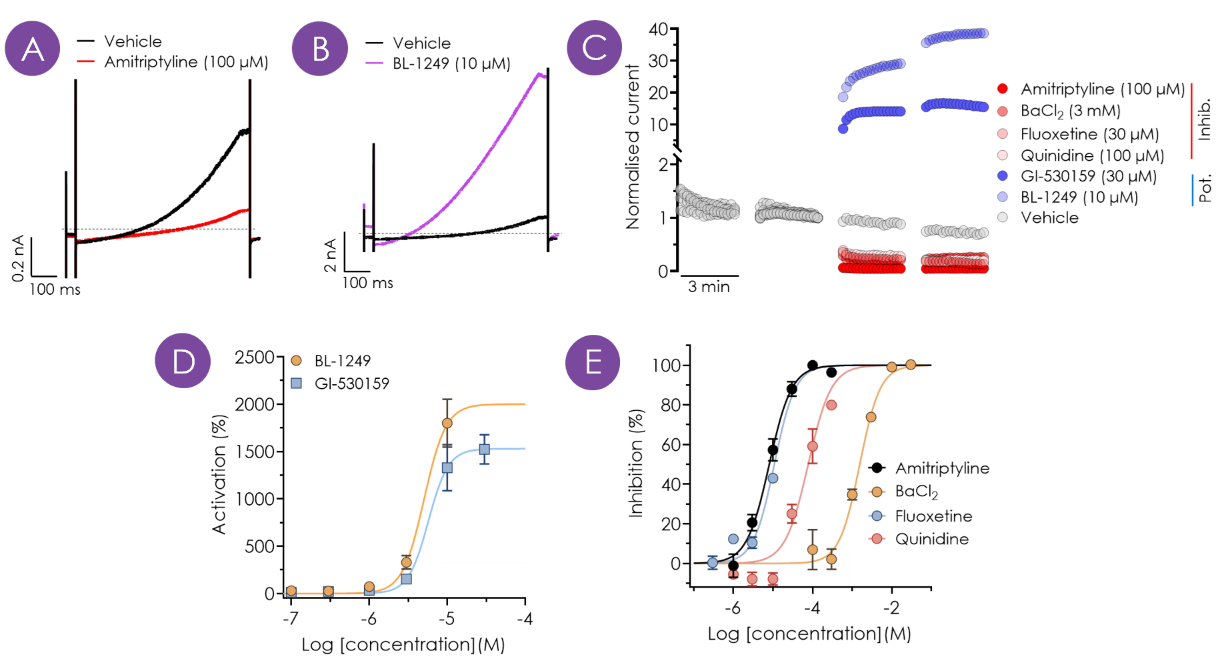
Figure 1. Pharmacological assessment of hTREK-1. (A,B) Representative traces of hTREK-1 current response when exposed to amitriptyline (A, 100 μM) or BL-1249 (B, 10 μM). (C) Representative current-time plots of cells exposed to vehicle (0.3 % v/v DMSO) or inhibitor (‘Inhib.’) or potentiator (‘Pot.’). (D,E) Concentration-response curves for potentiators (D) or inhibitors (E). IC50s (µM): amitriptyline – 8.08, BaCl2 – 1552, fluoxetine – 10.8, quinidine – 77.6. EC50s (µM): BL-1249 – 5.06, GI-530159 – 5.73.

High-throughput screening, species selectivity profiling and mechanistic evaluation of NaV1.9 for chronic pain research

The demand for chronic pain treatment is expanding and NaV1.9 has emerged as a high-value therapeutic target. Drug discovery research on NaV1.9 has long been hampered by difficulties in obtaining heterologous expression suitable for screening.

NaV1.9 screening cascade

An extensive NaV1.9 screening cascade has been developed by Metrion, bridging initial high-throughput hit generation of library molecules on our automated patch clamp system to translational characterisation in a native system, of a lead molecule via manual patch clamp.

The cascade starts with a robust hNaV1.9-expressing cell line, generated in-house, capable of reproducible pharmacology and supporting HTS campaigns via automated patch clamp electrophysiology. In addition, we offer a validated rat NaV1.9 expressing cell line for species selectivity screening on our high-throughput automated patch clamp system.

Our rat NaV1.9-expressing cell demonstrates similar current expression and performance to the hNaV1.9 expressing cell line, while sharing comparable pharmacology for standard sodium channel toolkit compounds.
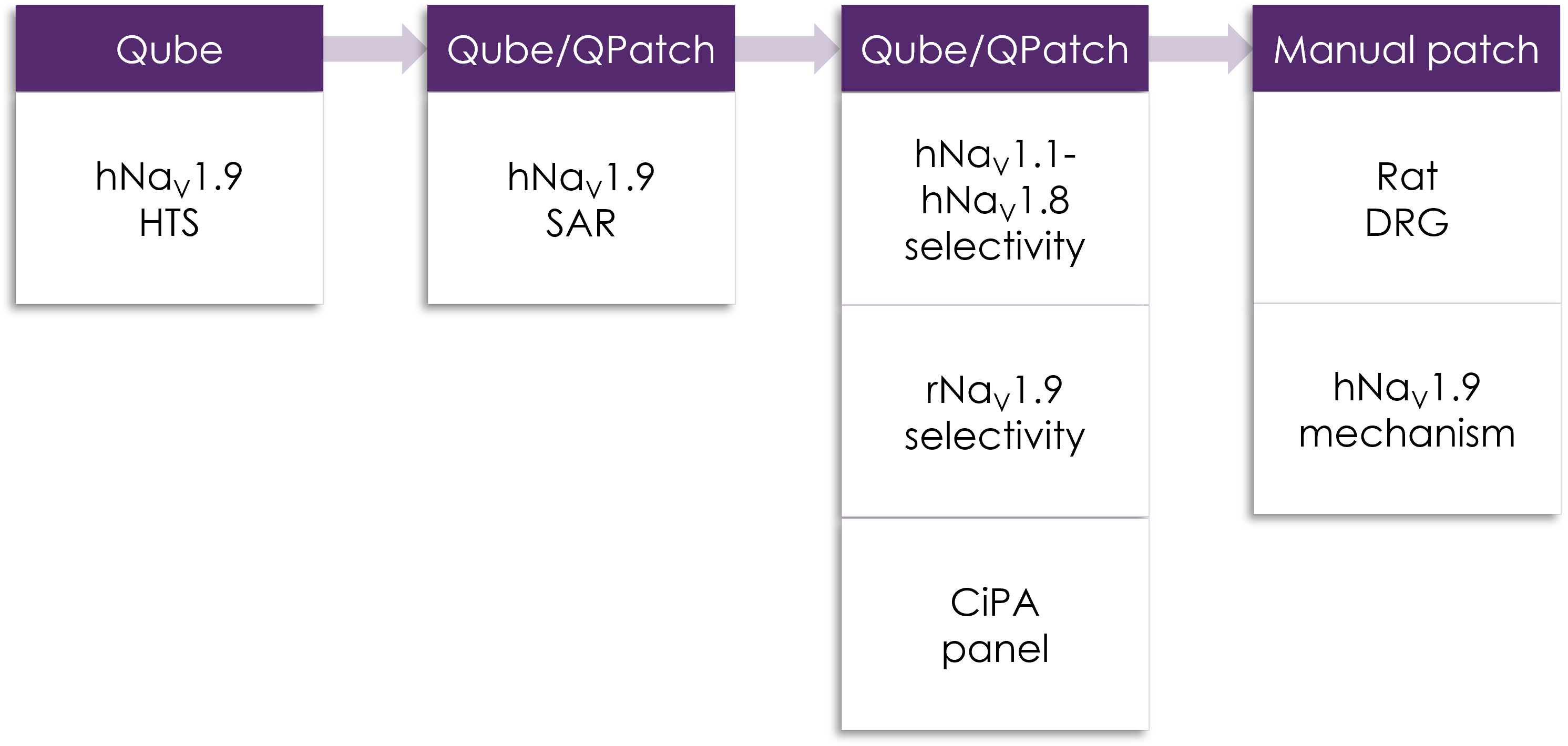
Figure 2. Example of Metrion's NaV1.9 screening cascade.

Long standing expertise in neuroscience drug discovery

Metrion’s longstanding expertise in neuroscience has enabled us to develop a manual patch clamp assay to evaluate endogenous NaV1.9 in rodent dorsal root ganglion neurons.

The synergy of high-quality manual patch clamp analysis with NaV1.9 expressed endogenously within a native neuron, provides an opportunity for mechanistic insight and a translational perspective of compound effects on neuronal firing behaviour.
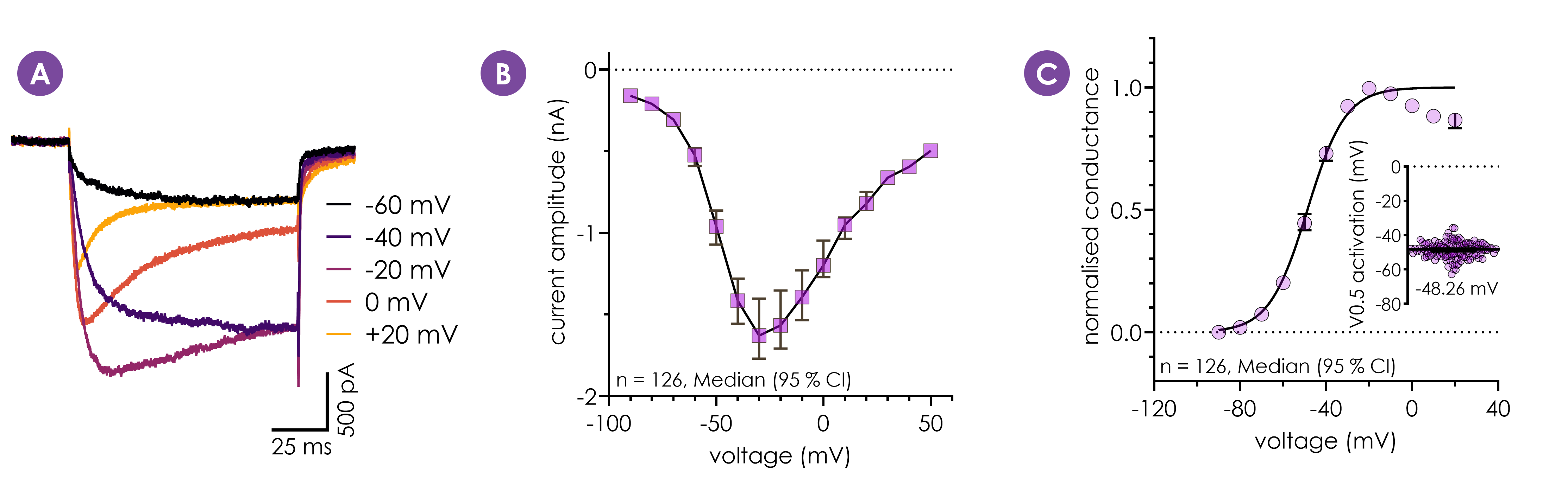
Figure 3. Activation characteristics of hNaV1.9 using automated patch clamp. (A) Representative traces of hNaV1.9 at a selection of voltages. (B,C) IV plot (B) and GV plot (C) of hNaV1.9 activation. V0.5 activation was estimated to be –48 mV.
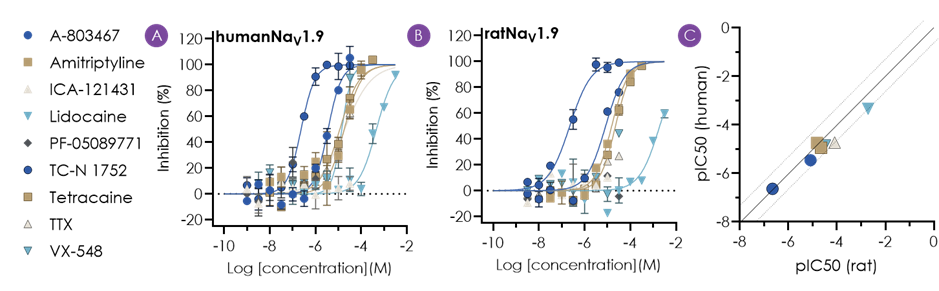
Figure 4. Species comparison of NaV1.9 pharmacology using automated patch clamp electrophysiology. (A,B) A test set of NaV inhibitors were tested against human (A) and rat (B) isoforms of NaV1.9. (C) A comparison of IC50s for the compounds that elicited >50 % inhibition. Solid line represents human pIC50 = rat pIC50, dashed lines represent a 3-fold shift, in both directions, in pIC50.


Translational peripheral neuronal assays and platforms to progress your drug discovery programme

Validating compounds in translational assays is vital to progressing your drug discovery programme.

A range of translational, phenotypic neuronal assays and platforms are offered by Metrion. These can employ native rodent from the peripheral nervous system or human iPSC-derived sensory neurons. The assays are useful for determining the efficacy, potency and mechanism-of-action of customer compounds designed to treat diseases such as pain and inflammation.

Primarily focusing on functional readouts, we use manual patch (voltage and current clamp) and calcium imaging platforms to record changes in single cell behaviour, and determine the effects of media, cell biology modulators, signalling pathways and test compounds.

These assays often need to be specifically designed for your translational neuroscience and drug discovery needs, please contact us with your requirements.

Preclinical assays to avoid costly off-target effects and cardiac safety issues

To compliment your primary compound screening program Metrion offers a broad range of electrophysiological and translational safety assays across a selection of platforms for early cardiac derisking. These assays help overcome the major hurdle cardiac liability poses for drug discovery programme.

Cardiac ion channel screening has been fundamental to Metrion’s success. We are ambitious in our offering and are always looking to expand our capabilities.

Manual or automated patch clamp can be used for efficient screening of hERG, as well as the wider CiPA panel of cardiac ion channels (CaV1.2, NaV1.5, KVLQT1, KV4.3, Kir2.1, KV1.5, HCN4).

Our MHRA-accredited GLP hERG testing service is further offered as part of the manual patch clamp service, providing you with the highest quality, FDA-compliant hERG screening for your IND filing.

For a translational output, we offer high value, clinically relevant, hiPSC-cardiomyocyte assays via manual patch clamp, for investigation of acute compound effect, and a 96-well plate-based fluorescence assay, for chronic investigation on cardiomyocyte toxicity.

Frequently asked questions

Why are ion channels important targets for pain drug discovery?

Ion channels are directly involved in the generation and propagation of pain signals. Modulating ion channel activity can reduce neuronal excitability and pain transmission, making ion channels attractive therapeutic targets for chronic pain, neuropathic pain and inflammatory pain.

What is NaV1.9 and why is it important for chronic pain research?

NaV1.9 is a voltage-gated sodium channel predominantly expressed in peripheral sensory neurons. It plays an important role in regulating neuronal excitability and has emerged as a promising therapeutic target for chronic pain conditions. However, screening for NaV1.9 has historically been challenging due to difficulties in obtaining robust heterologous expression systems.

What is the difference between NaV1.7, NaV1.8 and NaV1.9?

Although all three channels are involved in pain signalling, they play distinct roles in sensory neuron function. NaV1.7 is associated with pain signal initiation, NaV1.8 contributes to action potential propagation in nociceptors, and NaV1.9 influences neuronal excitability and persistent pain signalling. Together, they represent some of the most important sodium channel targets in pain drug discovery.

Why are translational neuronal assays important in pain research?

Translational neuronal assays provide biologically relevant data that help researchers understand how compounds affect neuronal function in more physiologically relevant systems. These assays can improve confidence in candidate selection and support progression towards clinical development.

How are human iPSC-derived sensory neurons used in pain drug discovery?

Human induced pluripotent stem cell (iPSC)-derived sensory neurons provide a human-relevant model for evaluating compound activity, potency and mechanism of action. They can help bridge the gap between ion channel screening and clinical outcomes.

Why is cardiac safety important in pain drug discovery?

Many compounds designed to treat pain can also interact with cardiac ion channels, potentially causing cardiac liabilities such as QT prolongation or arrhythmias. Early cardiac safety screening helps identify and mitigate these risks before clinical development.

Neuroscience Resource Library
Pharmacological assessment of hNav1.9 and rNav1.9 using Qube automated patch clamp

Using Qube 384, we profiled a panel of NaV inhibitors across species, providing valuable translational insight early in analgesic drug discovery.

Biophysical assessment of hNav1.9 using QPatch and Qube automated patch clamp

We explore hNav1.9's unique fast and slow inactivation properties using Qube 384 and QPatch 48 platforms, helping to build more predictive screening assays for state-dependent inhibitors.

VIEW ALL RESOURCES
magnifier
linkedin facebook pinterest youtube rss twitter instagram facebook-blank rss-blank linkedin-blank pinterest youtube twitter instagram