Chronic cardiotoxicity screening services using hiPSC-derived cardiomyocytes

CONTACT US

Assess long-term drug-induced cardiac risk using human-relevant models

Cardiotoxicity is a major cause of adverse health effects in patients and a significant contributor to drug attrition during development. As drug discovery advances, there is an increasing need for reliable and predictive methods to identify cardiac safety liabilities earlier in the development process. Traditional in vitro models and animal studies do not always accurately predict human-specific cardiac responses, creating a need for more clinically relevant approaches.

Metrion provides chronic cardiotoxicity screening services using human induced pluripotent stem cell (hiPSC)-derived cardiomyocytes and impedance-based analysis. Our validated assay enables the assessment of both structural and functional cardiotoxic effects following prolonged compound exposure, helping drug developers identify potential cardiac liabilities earlier and make more informed progression decisions.

By combining human-relevant cardiac models with continuous, non-invasive monitoring, the assay provides valuable insight into drug-induced cardiac damage and supports the development of safer and more effective therapeutics.

Validated chronic cardiotoxicity assays for drug discovery: A novel approach to long-term screening for drug safety

Metrion's chronic cardiotoxicity assay using hiPSC-derived cardiomyocytes has been validated with a range of toxicant compounds. The assay takes advantage of base impedance measurements to assess both the structural and functional cardiotoxic effects of drug compounds over a prolonged period.

Unlike traditional endpoint assays, impedance-based monitoring enables continuous assessment of cardiomyocyte responses over time, providing insight into the onset, progression and severity of compound-induced cardiac toxicity. This allows researchers to evaluate long-term cardiac risk in a physiologically relevant human cell model while supporting both early-stage screening and more detailed toxicological investigations.

The ability to mimic chronic cardiotoxicity in vitro offers a significant advantage over traditional acute assays, which may not fully capture the longer-term effects of compounds on cardiac function. In addition, the assay is highly adaptable and can be used to evaluate both established toxicants and novel drug candidates.

Doxorubicin case study: Assessing chronic cardiotoxicity in a human-relevant model

An important example of this assay's application is the testing of doxorubicin, a chemotherapy drug widely used to treat various cancers, including breast cancer.

While highly effective, doxorubicin is associated with a range of serious cardiac side effects, including acute and chronic arrhythmias, cardiomyopathy and congestive heart failure. These adverse effects can occur months or even years after treatment, making long-term cardiovascular risk difficult to assess using traditional short-duration models.

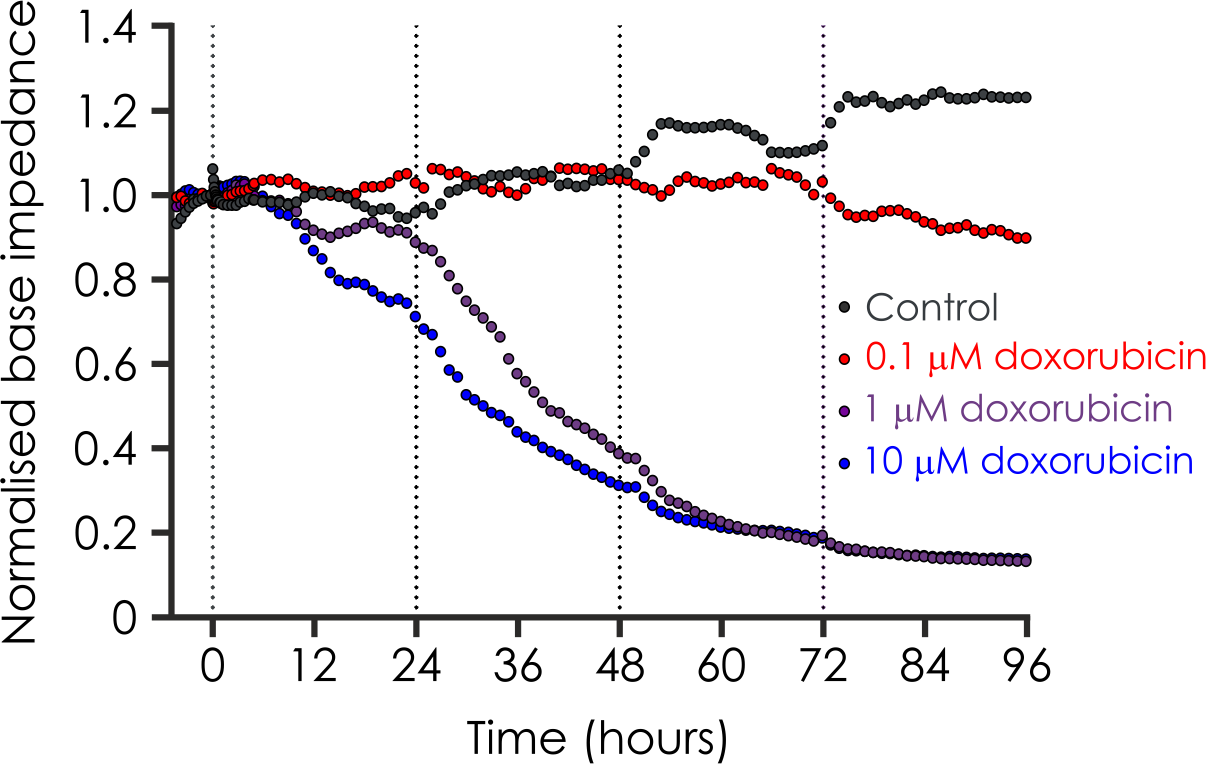
Metrion's chronic cardiotoxicity assay successfully recapitulates the known cardiotoxic effects of doxorubicin by producing a concentration-dependent decrease in base impedance following a 24-hour exposure period. This reduction in impedance reflects the structural and functional damage caused by the drug, ultimately leading to compromised cardiomyocyte viability (Figure 1).

By providing continuous, real-time monitoring of these changes, the assay enables assessment of the cumulative effects of doxorubicin over time and offers a powerful tool for investigating chronic cardiac risk in a more human-relevant context.

Figure 1: Effects of Doxorubicin on hiPSC impedance using CardioExcyte.

Impedance-based assessment of structural and functional cardiotoxicity

Base impedance is a measure of the electrical resistance of living cells in response to an external signal and serves as an important indicator of cell viability, cellular health and overall function.

Changes in base impedance can reflect alterations in cell morphology, membrane integrity and the functionality of ion channels and transporters, all of which are critical for maintaining healthy cardiomyocyte function.

In the context of cardiotoxicity testing, impedance-based analysis provides a non-invasive and highly sensitive approach for detecting both structural and functional changes in cardiomyocytes over time. Traditional methods such as histological analysis or conventional endpoint assays may not capture the full spectrum of cardiotoxic effects, particularly during the early stages of compound exposure.

Continuous impedance monitoring allows researchers to track cardiomyocyte responses throughout the study period and generate valuable insight into compound effects on:

  • Cell viability
  • Cellular health and morphology
  • Membrane integrity
  • Contractile behaviour
  • Electrical activity
  • Long-term cardiac function
  • Progressive toxic effects following repeated exposure

By assessing these parameters over an extended time course, researchers can gain a deeper understanding of the long-term consequences of drug exposure on cardiac health.

Why use hiPSC-derived cardiomyocytes for cardiotoxicity testing?

Human induced pluripotent stem cells (hiPSCs) are a powerful tool in modern biomedical research. Derived from adult somatic cells and reprogrammed to a pluripotent state, hiPSCs can be differentiated into cardiomyocytes that closely resemble human heart cells.

The use of hiPSC-derived cardiomyocytes provides a unique and highly relevant model for studying human-specific cardiac responses to drug exposure. Because these cells are genetically human, they are more representative of human cardiac physiology and pathology than many traditional animal-derived models.

This enables more accurate prediction of how a compound may affect human heart tissue and helps reduce the risk of false positive or false negative findings that can occur when relying solely on animal testing.

For drug developers, this level of physiological relevance is invaluable for identifying potential cardiotoxicity risks earlier in development and supporting the advancement of safer and more effective therapies.

Why choose Metrion as your CRO for chronic cardiotoxicity studies?

Metrion combines extensive cardiac safety expertise with human-relevant cellular models to deliver high-quality chronic cardiotoxicity studies.

Our chronic cardiotoxicity screening services provide:

  • Human hiPSC-derived cardiomyocyte models
  • Assessment of both structural and functional cardiotoxicity
  • Continuous impedance-based monitoring
  • Long-term evaluation of compound effects
  • Validation using known cardiotoxic compounds
  • Higher-throughput 96-well screening capability
  • Expert scientific interpretation and data analysis

By generating clinically relevant cardiac safety data earlier in development, we help clients de-risk programmes, strengthen compound selection decisions and improve confidence in cardiac safety assessment.

Frequently asked questions

What is chronic cardiotoxicity?

Chronic cardiotoxicity refers to adverse effects on cardiac structure or function that develop following prolonged or repeated exposure to a therapeutic compound.

Why use hiPSC-derived cardiomyocytes for cardiotoxicity testing?

hiPSC-derived cardiomyocytes provide a human-relevant model that enables assessment of compound effects on cardiac viability, morphology and function in cells that closely resemble human heart tissue.

What does impedance measure in cardiotoxicity assays?

Impedance measurements provide information about cell viability, morphology, membrane integrity and cardiomyocyte function. Changes in impedance can indicate both structural and functional cardiotoxic effects.

What compounds can be evaluated using Metrion's chronic cardiotoxicity assay?

The assay can be used to assess known toxicants, lead compounds and novel drug candidates where long-term cardiac safety assessment is required.

What are the advantages of chronic cardiotoxicity testing?

Chronic cardiotoxicity studies can identify cardiac liabilities that may not be detected in short-duration assays, providing valuable insight into long-term cardiac risk and supporting more informed drug development decisions.

Who produces the CardioExcyte?

The CardioExcyte platform is developed by Nanion Technologies, a leading provider of electrophysiology and cell-based assay instrumentation for drug discovery and safety assessment. CardioExcyte combines impedance and extracellular field potential measurements, enabling the assessment of cardiomyocyte function, viability and drug-induced cardiotoxicity in human-relevant cellular models.


Cardiac Safety Screening Resource Library
Future-proof cardiac safety: Scalable hiPSC cardiomyocyte new approach methodologies (NAMs) that de-risk earlier and strengthen IND packages

The key question is no longer whether to adopt NAMs, but how to implement them with confidence while continuing to meet evolving regulatory expectations and protecting programme value.

Action Potential Waveform Analysis in Human iPSC-Cardiomyocytes Enables Mechanistic Assessment of Multichannel Cardiac Effects

Optical voltage imaging of human iPSC-derived cardiomyocytes was used to assess electrophysiological effects of compounds beyond hERG inhibition. Action potential waveform analysis revealed compound-specific and concentration-dependent changes, enabling mechanistic differentiation of multichannel activity and demonstrating a human-relevant approach for translational cardiac safety assessment.

VIEW ALL RESOURCES
Metrion is a contract research organisation (CRO) specialising in high-quality preclinical drug discovery services.
magnifier
linkedin facebook pinterest youtube rss twitter instagram facebook-blank rss-blank linkedin-blank pinterest youtube twitter instagram