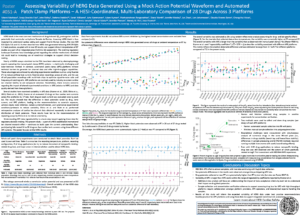
At the Safety Pharmacology Society 2024 meeting, a Health and Environmental Sciences Institute (HESI) Cardiac Safety Committee poster presented results from an international ion channel research study that assessed the variability of hERG data generated using automated patch clamp platforms (QPatch 48, Qube 384 and the SyncroPatch 384i) across four different labs. The experimental methods were standardized as much as possible, which included the use of a mock action potential voltage protocol.
The assay was used to assess the potency of twenty-eight compounds, with known proarrhythmic liability profiles, on the hERG potassium channel. While no systematic differences in the results were observed amongst the participating labs, the overall variability was estimated as 16x using random-effect meta-analysis accounting for drug- and lab-specific effects whixch is higher than that obtained using the conventional manual patch-clamp technique. Concentration verification analysis revealed that there was a correlation between the loss of compound and their LogP.
Thank you to HESI for inviting Metrion to contribute to this important work.