Action Potential Waveform Analysis in Human IPSC-Cardiomyocytes Enables Mechanistic Assessment of Multichannel Cardiac Effects

Molly Rowlett, Thomas Hill, Scott Maidment, Luke Marrington, Ayesha Jinat, Alexandra Pinggera, Katie Puddefoot, Gary Clark, Zeki Ilkan, Robert Kirby, Graham Smith
Metrion Biosciences Ltd, Granta Centre, Granta Park, Cambridge, CB21 6AL, United Kingdom
TRPML1 (transient receptor potential mucolipin subfamily 1) is a non-selective cation channel primarily localised in late endosomes and lysosomes. Channel activity is regulated by both calcium (Ca2+) and pH. TRPML1 facilitates Ca2+ efflux from the lysosomal lumen and is, therefore, vital for vesicular trafficking processes such as exocytosis and autophagy1.
Mutations in the gene encoding the channel protein (MCOLN1) results in lysosomal storage diseases, such as Mucolipidosis type IV (ML4) which presents as motor deficits, neurodegeneration and visual impairments2.
The development and validation of ion channel screening assays to study TRPML1 is important to understand the function and pharmacology of the channel. Here, we used a TRPML1 variant that lacks the endo-lysosomal retention sequences (TRPML1-4A), enabling the channel to express at the plasma membrane3. As such channel behaviour can be characterised by means of whole-cell patch-clamp and fluorescence-based techniques.
To develop a suite of screening assays using manual patch-clamp, automated patch-clamp and fluorescence-based platforms capable of identifying modulators of the TRPML1-4A channel.
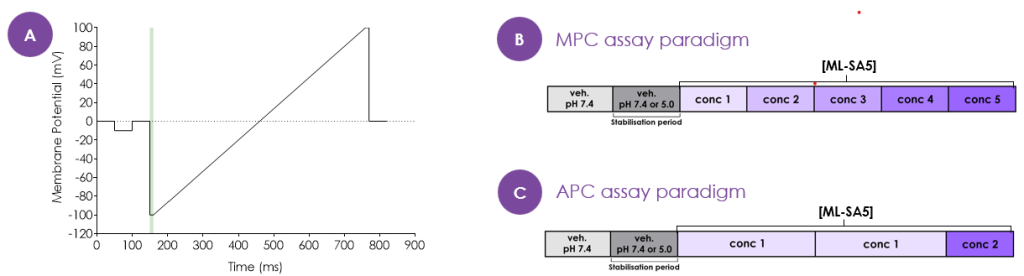
The intracellular (ICS) and extracellular solutions (ECS) used in patch-clamp assays are summarised below:
ICS (in mM); CsF 120, NaCl 15, CaCl2 1, MgCl2 1, HEPES/Citric acid 10, EGTA 10, pH 7.2.
ECS for MPC (in mM); NMDG 100, NaCl 35, KCl 5, CaCl2 0.5, MgCl2 1, HEPES/Citric acid 10, Glucose 11.1, pH 7.4/5.
ECS for APC (in mM); NaCl 140, KCl 13, CaCl2 1, MgCl2 1, BaCl2 4, HEPES/MES 10, pH 7.4/5.


The reference agonist, ML-SA5 was tested at 10 concentrations (0.0003 to 10 µM) at pH 7.4.
Two assay runs were performed to ensure reproducibility between experiments.
Area under curve was calculated for each well and concentration-response curves were constructed.

Action Potential Waveform Analysis in Human IPSC-Cardiomyocytes Enables Mechanistic Assessment of Multichannel Cardiac Effects
Cardiac toxicity remains the leading cause of new drug safety side-effects. Current preclinical cardiac safety assays rely on in vitro cell-based ion channel assays and ex vivo and in vivo animal models⁽¹⁾. These assays provide an indication of acute risk but they do not always predict the effect of chronic compound exposure, as recently seen with oncology drugs. Therefore, new assays are required to characterise chronic structural and functional effects in human cells earlier in drug discovery. Impedance-based technology can provide more accurate chronic cardiotoxicity measurements in an efficient manner using human induced pluripotent stem cell-derived cardiomyocytes (hiPSC-CMs).