
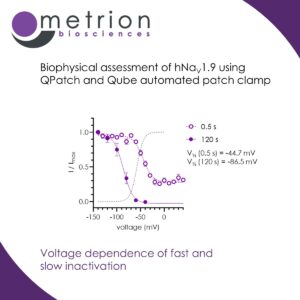
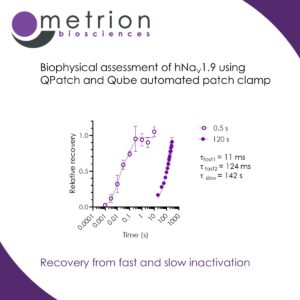
Biophysical assessment of hNav1.9 using QPatch and Qube automated patch clamp

Data Card

NaV1.9 behaves very differently from other sodium channel isoforms, so working with a partner who understands those differences intricately is critical to drive your project forward.

We explore the channel’s unique fast and slow inactivation properties using Qube 384 and QPatch 48 platforms, helping to build more predictive screening assays for state-dependent inhibitors. Download the poster ‘Evaluation of hNav1.9 Screening Cascade for Analgesic Drug Discovery’.

This depth of biophysical understanding is what allows us to design assays that go beyond routine screening. Contact us to learn more.


Biophysical assessment of hNaV1.9 using QPatch and Qube automated patch clamp Biophysical assessment of hNaV1.9 using QPatch and Qube automated patch clamp

Recommended Publications
Latest Publications
An Integrated Assay Platform for Mechanistic and Translational Profiling of Kv7.2/7.3 Activators

An integrated assay platform was developed to characterise the pharmacological and physiological effects of Kv7.2/7.3 activators. Combining high-throughput FLIPR thallium flux, automated voltage- and current-clamp electrophysiology, and sensory neuron recordings enabled assessment of compound potency, mechanism of action, and effects on neuronal resting membrane potential. Profiling of retigabine, flupirtine, ML213, ICA 069673, XEN1101 and opakalim demonstrated distinct pharmacological profiles across complementary assay systems. The workflow provides a mechanistic and translational approach for characterising Kv7.2/7.3 activators and their effects on neuronal excitability.

Action Potential Waveform Analysis in Human iPSC-Cardiomyocytes Enables Mechanistic Assessment of Multichannel Cardiac Effects

Optical voltage imaging of human iPSC-derived cardiomyocytes was used to assess electrophysiological effects of compounds beyond hERG inhibition. Action potential waveform analysis revealed compound-specific and concentration-dependent changes, enabling mechanistic differentiation of multichannel activity and demonstrating a human-relevant approach for translational cardiac safety assessment.

View All
magnifier
linkedin facebook pinterest youtube rss twitter instagram facebook-blank rss-blank linkedin-blank pinterest youtube twitter instagram