
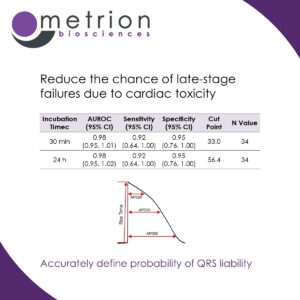
 Reduce the chance of late-stage failures due to cardiac toxicity
An integrated assay platform was developed to characterise the pharmacological and physiological effects of Kv7.2/7.3 activators. Combining high-throughput FLIPR thallium flux, automated voltage- and current-clamp electrophysiology, and sensory neuron recordings enabled assessment of compound potency, mechanism of action, and effects on neuronal resting membrane potential. Profiling of retigabine, flupirtine, ML213, ICA 069673, XEN1101 and opakalim demonstrated distinct pharmacological profiles across complementary assay systems. The workflow provides a mechanistic and translational approach for characterising Kv7.2/7.3 activators and their effects on neuronal excitability.