
The KV7 channel family (KV7.1-Kv7.5), encoded by KCNQ1-KCNQ5, play a fundamental role in regulating cellular excitability by stabilising the resting membrane potential and controlling action potential firing. Each subtype exhibits distinct tissue distribution and physiological function. KV7.1 is primarily involved in cardiac repolarisation, whereas KV7.2-KV7.5 are expressed throughout the central and peripheral nervous systems and represent attractive therapeutic targets for epilepsy, neuropathic pain, hearing disorders and hypertension.
KV7 drug discovery faces several challenges, including high degree of structural homology between isoforms, distinct functional and pharmacological properties of individual subunits and channel combinations, and, crucially, poor translation of in vitro efficacy in vivo. Clinical promise was demonstrated by retigabine (ezogabine), the first clinically approved KV7 channel opener for the treatment of focal onset seizures. However, its subsequent withdrawal highlighted the challenges associated with adverse effects due to limited subtype selectivity across KV7 channels and underscores the current focus in the industry to develop next-generation subtype-selective activators with improved efficacy and safety profiles.
Metrion offers a comprehensive approach to KV7 screening, helping clients bridge the gap between KV7 pharmacology and functional physiology. By combining specialist expertise with complementary technologies, we deliver detailed insights into potency, selectivity, mechanism of action and physiological relevance of compounds, providing deeper mechanistic and translational understanding.
As demonstrated in our poster, ‘An Integrated Assay Platform for Mechanistic and Translational Profiling of KV7.2/7.3 Activators’, Metrion’s integrated assay platform combines high-throughput screening using a FLIPR® Penta thallium dye assay with Qube 384 and QPatch 48 voltage clamp profiling to characterise the biophysical effects of KV7 activators. This is complemented by QPatch 48 current clamp and translational manual patch clamp studies to assess their functional effects on resting membrane potential. Together, this workflow addresses the critical challenge in KV7 drug discovery that compounds with similar apparent pharmacological profiles can produce divergent physiological effects.
Our FLIPR® Penta thallium flux assay provides a high-throughput method to determine potency and rank order of KV7 activators across a range of potencies (Figure 1).
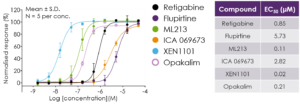
Figure 1 – Potency of KV7.2/7.3 activators assessed using a FLIPR Penta thallium flux assay. EC50 concentration-response curves normalised to 0.5 % DMSO and 50 µM retigabine.
FLIPR potencies robustly translate to automated voltage clamp electrophysiology (Qube 384), enabling more precise characterisation of compound mechanisms of action through shifts in V0.5 activation and changes in maximal conductance (Gmax) (Figure 2).
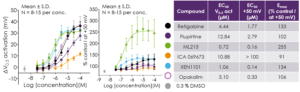
Figure 2 – Pharmacological effects of KV7.2/7.3 activators characterised using automated voltage clamp electrophysiology (Qube 384). EC50 potency assessment of compounds on KV7.2/7.3 V0.5 activation and current (I) at +50 mV.
Automated current clamp assays on the QPatch 48 physiologically integrate V0.5 and Gmax endpoints to assess compound effects on cell resting membrane potential (Figure 3). This can be used to triage key KV7 activator compounds prior to validation in translational sensory neuron recordings (Figure 4), linking pharmacological mechanism to neuronal excitability.
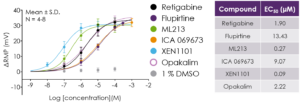
Figure 3 – KV7.2/7.3 activators hyperpolarise the resting membrane potential (RMP) of U2‑OS‑KV7.2/7.3 cells. EC50 potency assessment of KV7.2/7.3 activators on RMP using QPatch 48. Maximal hyperpolarisation approaches EK.
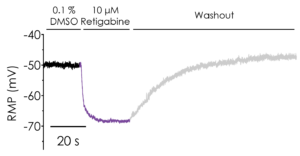
Figure 4 – Sensory neuron hyperpolarisation by retigabine using manual patch clamp. Example trace showing sensory neuron resting membrane potential hyperpolarisation in response to 10 µM retigabine acting on native KV7 channels.
Underpinned by our rigorous scientific interpretation of data and extensive expertise in KV7 pharmacology and drug discovery, we support clients in differentiating KV7 activator modalities and understanding how these translate into functional outcomes in heterologous and neuronal models. These insights help inform compound selection and optimisation, supporting the development of novel KV7 activators with improved therapeutic potential.
KV7 channels are slow-activating, non-inactivating voltage-gated potassium channels that play a fundamental role in cellular excitability. KV7.1 is primarily involved in cardiac repolarisation, KV7.2 and Kv7.3 are key regulators of neuronal excitability, KV7.4 is expressed in the inner ear, throughout the auditory pathway and in smooth muscle, and KV7.5 is expressed in neuronal and smooth muscle tissues.
Their physiological role regulating cellular excitability by stabilising the resting membrane potential and their distinct tissue distributions make them attractive targets for disorders that involve hyperexcitability, such as epilepsy (KV7.2/7.3), neuropathic pain (KV7.2/7.3), hearing impairment (KV7.4) and hypertension (KV7.4 and KV7.5).
KV7 drug discovery faces several challenges, including high degree of structural homology between isoforms, distinct functional and pharmacological properties of individual subunits and channel combinations, and, crucially, poor translation of in vitro efficacy in vivo.
Through systematic characterisation of compound activity across multiple KV7 subtypes and assay formats, Metrion enables clients to identify promising candidates, address potential selectivity and safety liabilities at an early stage and make informed decisions throughout the drug discovery process, accelerating development timelines.
Thallium flux is a fluorescence-based functional assay used to measure potassium channel activity. The assay exploits the fact that thallium ions can pass through open potassium channels, acting as a surrogate for potassium ions. Metrion uses a Functional Imaging Plate Reader (FLIPR) Penta developed by Molecular Devices, a powerful technology for high-throughput screening of ion channel targets.
The Qube 384 and QPatch 48 automated patch clamp systems are developed by Sophion Bioscience, a leading provider of electrophysiology instrumentation used throughout the pharmaceutical, biotechnology and CRO sectors. These platforms are widely adopted for ion channel research and drug discovery, enabling the generation of high-quality electrophysiology data for compound screening, pharmacological profiling and lead optimisation studies. Metrion uses both QPatch and Qube systems to provide flexible screening solutions ranging from detailed pharmacological investigations to higher-throughput compound evaluation.
Voltage clamp and current clamp are two electrophysiological techniques. Voltage clamp controls the membrane voltage of a cell and current is measured to characterise ion channel kinetics, voltage dependence and pharmacological responses. Current clamp controls the injected current whilst membrane voltage is recorded. This allows for studies to assess how compounds affect cell resting membrane potential, cellular excitability and neuronal firing.
Translational assays bridge the gap between early-stage compound activity in recombinant systems and meaningful physiological effects in more biologically relevant systems. Metrion offers a diverse range of translational assay capabilities incorporating sensory neurons, ex vivo brain slices, primary neuronal cultures, iPSC-derived cardiomyocytes and neuronal network assays using multi-electrode array (MEA). These assays establish whether pharmacological channel modulation translates into functional effects such as reduced cellular excitability and altered network firing, providing valuable insights into their physiological relevance and therapeutic potential.
The KV7 channel family (KV7.1-Kv7.5), encoded by KCNQ1-KCNQ5, play a fundamental role in regulating cellular excitability by stabilising the resting membrane potential and controlling action potential firing. Each subtype exhibits distinct tissue distribution and physiological function. KV7.1 is primarily involved in cardiac repolarisation, whereas KV7.2-KV7.5 are expressed throughout the central and peripheral nervous systems and represent attractive therapeutic targets for epilepsy, neuropathic pain, hearing disorders and hypertension.
KV7 drug discovery faces several challenges, including high degree of structural homology between isoforms, distinct functional and pharmacological properties of individual subunits and channel combinations, and, crucially, poor translation of in vitro efficacy in vivo. Clinical promise was demonstrated by retigabine (ezogabine), the first clinically approved KV7 channel opener for the treatment of focal onset seizures. However, its subsequent withdrawal highlighted the challenges associated with adverse effects due to limited subtype selectivity across KV7 channels and underscores the current focus in the industry to develop next-generation subtype-selective activators with improved efficacy and safety profiles.
Metrion offers a comprehensive approach to KV7 screening, helping clients bridge the gap between KV7 pharmacology and functional physiology. By combining specialist expertise with complementary technologies, we deliver detailed insights into potency, selectivity, mechanism of action and physiological relevance of compounds, providing deeper mechanistic and translational understanding.
As demonstrated in our poster, ‘An Integrated Assay Platform for Mechanistic and Translational Profiling of KV7.2/7.3 Activators’, Metrion’s integrated assay platform combines high-throughput screening using a FLIPR® Penta thallium dye assay with Qube 384 and QPatch 48 voltage clamp profiling to characterise the biophysical effects of KV7 activators. This is complemented by QPatch 48 current clamp and translational manual patch clamp studies to assess their functional effects on resting membrane potential. Together, this workflow addresses the critical challenge in KV7 drug discovery that compounds with similar apparent pharmacological profiles can produce divergent physiological effects.
Our FLIPR® Penta thallium flux assay provides a high-throughput method to determine potency and rank order of KV7 activators across a range of potencies (Figure 1).
Figure 1 – Potency of KV7.2/7.3 activators assessed using a FLIPR Penta thallium flux assay. EC50 concentration-response curves normalised to 0.5 % DMSO and 50 µM retigabine.
FLIPR potencies robustly translate to automated voltage clamp electrophysiology (Qube 384), enabling more precise characterisation of compound mechanisms of action through shifts in V0.5 activation and changes in maximal conductance (Gmax) (Figure 2).
Figure 2 – Pharmacological effects of KV7.2/7.3 activators characterised using automated voltage clamp electrophysiology (Qube 384). EC50 potency assessment of compounds on KV7.2/7.3 V0.5 activation and current (I) at +50 mV.
Automated current clamp assays on the QPatch 48 physiologically integrate V0.5 and Gmax endpoints to assess compound effects on cell resting membrane potential (Figure 3). This can be used to triage key KV7 activator compounds prior to validation in translational sensory neuron recordings (Figure 4), linking pharmacological mechanism to neuronal excitability.
Figure 3 – KV7.2/7.3 activators hyperpolarise the resting membrane potential (RMP) of U2‑OS‑KV7.2/7.3 cells. EC50 potency assessment of KV7.2/7.3 activators on RMP using QPatch 48. Maximal hyperpolarisation approaches EK.
Figure 4 – Sensory neuron hyperpolarisation by retigabine using manual patch clamp. Example trace showing sensory neuron resting membrane potential hyperpolarisation in response to 10 µM retigabine acting on native KV7 channels.
Underpinned by our rigorous scientific interpretation of data and extensive expertise in KV7 pharmacology and drug discovery, we support clients in differentiating KV7 activator modalities and understanding how these translate into functional outcomes in heterologous and neuronal models. These insights help inform compound selection and optimisation, supporting the development of novel KV7 activators with improved therapeutic potential.
KV7 channels are slow-activating, non-inactivating voltage-gated potassium channels that play a fundamental role in cellular excitability. KV7.1 is primarily involved in cardiac repolarisation, KV7.2 and Kv7.3 are key regulators of neuronal excitability, KV7.4 is expressed in the inner ear, throughout the auditory pathway and in smooth muscle, and KV7.5 is expressed in neuronal and smooth muscle tissues.
Their physiological role regulating cellular excitability by stabilising the resting membrane potential and their distinct tissue distributions make them attractive targets for disorders that involve hyperexcitability, such as epilepsy (KV7.2/7.3), neuropathic pain (KV7.2/7.3), hearing impairment (KV7.4) and hypertension (KV7.4 and KV7.5).
KV7 drug discovery faces several challenges, including high degree of structural homology between isoforms, distinct functional and pharmacological properties of individual subunits and channel combinations, and, crucially, poor translation of in vitro efficacy in vivo.
Through systematic characterisation of compound activity across multiple KV7 subtypes and assay formats, Metrion enables clients to identify promising candidates, address potential selectivity and safety liabilities at an early stage and make informed decisions throughout the drug discovery process, accelerating development timelines.
Thallium flux is a fluorescence-based functional assay used to measure potassium channel activity. The assay exploits the fact that thallium ions can pass through open potassium channels, acting as a surrogate for potassium ions. Metrion uses a Functional Imaging Plate Reader (FLIPR) Penta developed by Molecular Devices, a powerful technology for high-throughput screening of ion channel targets.
The Qube 384 and QPatch 48 automated patch clamp systems are developed by Sophion Bioscience, a leading provider of electrophysiology instrumentation used throughout the pharmaceutical, biotechnology and CRO sectors. These platforms are widely adopted for ion channel research and drug discovery, enabling the generation of high-quality electrophysiology data for compound screening, pharmacological profiling and lead optimisation studies. Metrion uses both QPatch and Qube systems to provide flexible screening solutions ranging from detailed pharmacological investigations to higher-throughput compound evaluation.
Voltage clamp and current clamp are two electrophysiological techniques. Voltage clamp controls the membrane voltage of a cell and current is measured to characterise ion channel kinetics, voltage dependence and pharmacological responses. Current clamp controls the injected current whilst membrane voltage is recorded. This allows for studies to assess how compounds affect cell resting membrane potential, cellular excitability and neuronal firing.
Translational assays bridge the gap between early-stage compound activity in recombinant systems and meaningful physiological effects in more biologically relevant systems. Metrion offers a diverse range of translational assay capabilities incorporating sensory neurons, ex vivo brain slices, primary neuronal cultures, iPSC-derived cardiomyocytes and neuronal network assays using multi-electrode array (MEA). These assays establish whether pharmacological channel modulation translates into functional effects such as reduced cellular excitability and altered network firing, providing valuable insights into their physiological relevance and therapeutic potential.