Automated patch clamp enables robust NaV1.9 screening, accelerating discovery of selective sodium channel modulators for pain research.

Alexander Haworth1, Jose Enrique Gonzalez-Prada2, Jacob Browne2, Catherine Hodgson1, Nicola Secomandi1, Christoper Mathes1, Tony Rush1, Paul Miller2, Edward Stevens1
1. Metrion Biosciences Ltd., First Floor, Building 2, Granta Centre, Granta Park, Cambridge, CB21 6AL, UK |
2. Department of Pharmacology, University of Cambridge, Tennis Court Road, Cambridge, CB2 1PD, UK
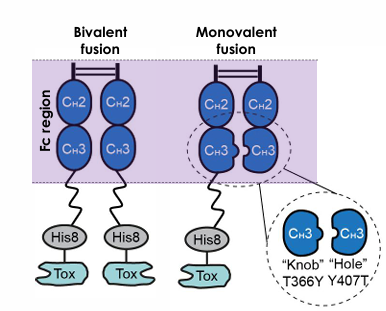
Toxin peptides (“Tox”) were fused to the Fc region of hIgG1 in monovalent form, except for HwTx-IV, which was also produced in bivalent form. Adapted from (3)
1. Screening of Fc-toxin peptide fusions against NaV1.7
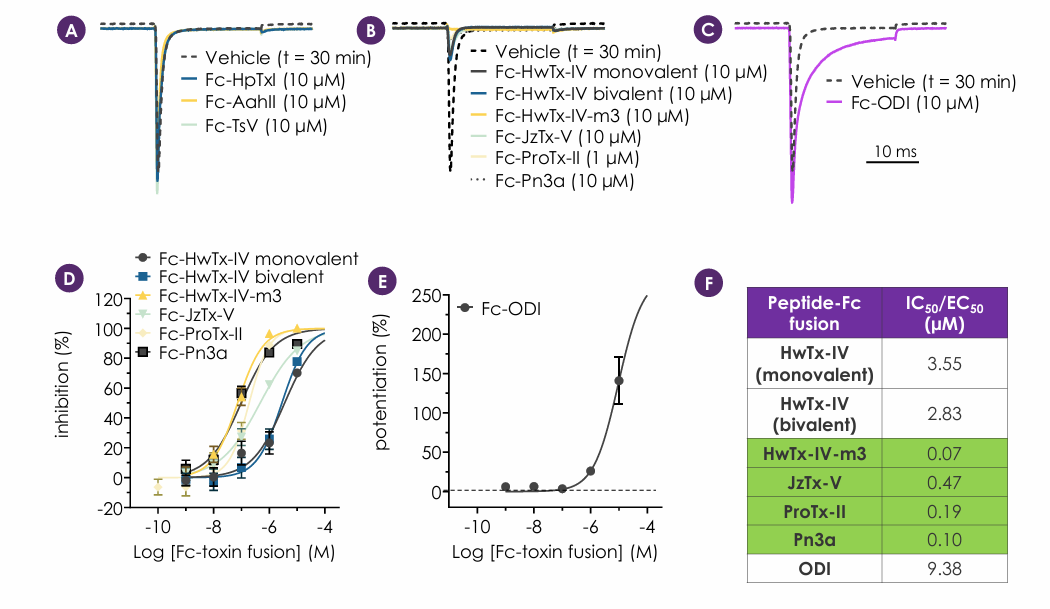
Fc-toxin fusions were screened against NaV1.7. Three of the fusions were inactive at the top concentration (A), whereas six demonstrated inhibitory activity (B,D) and one (ODI) potentiated NaV1.7 charge (C,E). The four most potent fusions, all inhibitors – HwTx-IV-m3, JzTx-V, ProTx-II and Pn3a, were selected for further screening (F).
2. NaV1.7 potency comparison between synthetic and Fc-toxin peptides
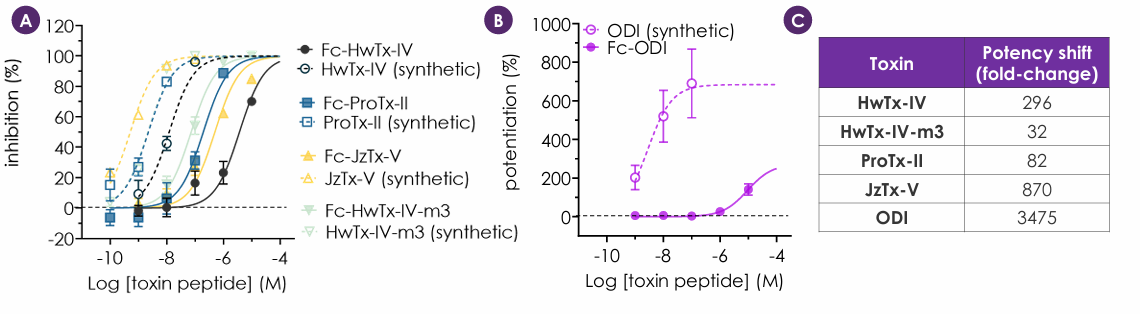
Fc-toxin peptide activity against NaV1.7 was benchmarked against their synthetic counterpart for the peptides which are commercially available (A,B). A loss of potency is common for recombinant, cysteine-rich peptides due to reduced folding success and lack of possible post-translational modifications. A 50-fold increase in IC50 has been reported for SUMO-HwTx-IV previously (1), which aligns with what was observed for Fc-fused HwTx-IV, HwTx-IV-m3 and ProTx-II (C). JzTx-V and OD1 demonstrated much larger shifts (C).
3. Reproducibility of Fc-toxin peptide fusions against NaV1.7
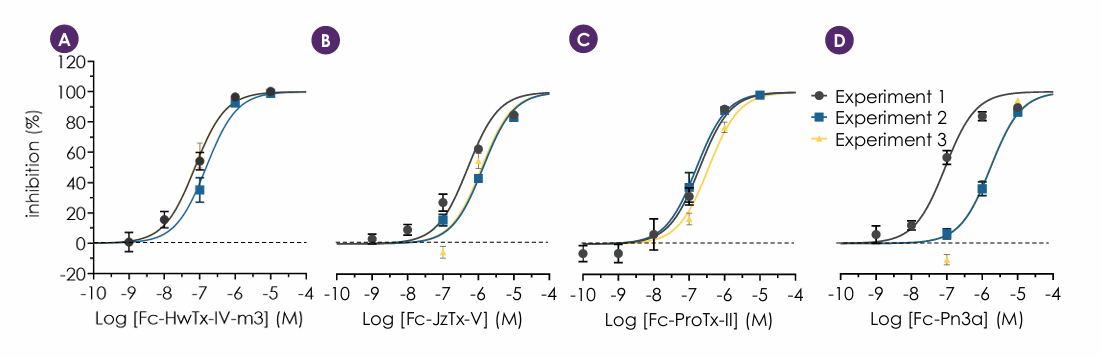
Fc-toxin peptide reproducibility was examined across the experiments performed against NaV1.7 for Fc-toxin fusions (A – D). HwTx-IV-m3, JzTx-V and ProTx-II all demonstrated good reproducibility.
4. Selectivity profiling of Fc-toxin peptide fusions
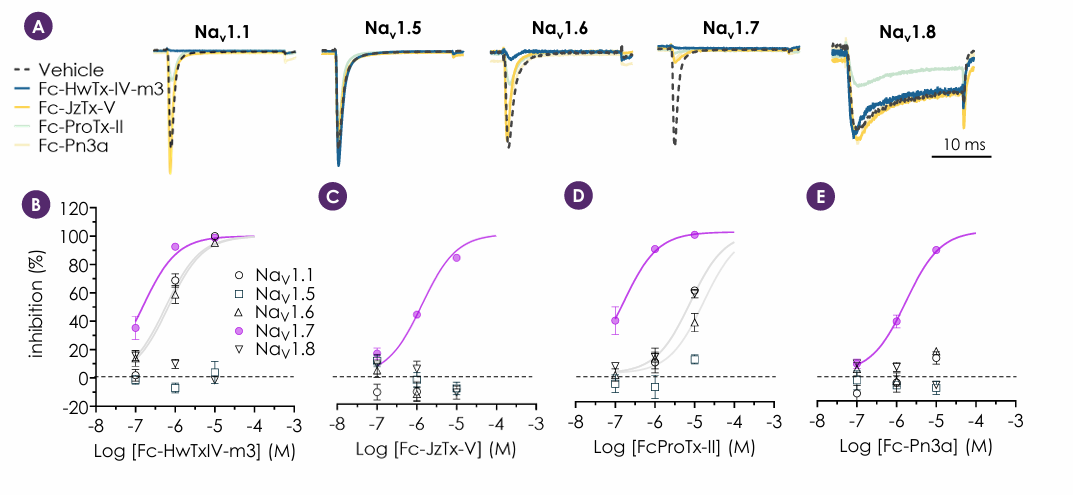
Fc-toxin peptide fusions were counter-screened against cardiac sodium channel (NaV1.5) and a range of sensory neuronal channels (NaV1.1, 1.6 and 1.8) (A). Fc-HwTx IV-m3 displayed acceptable potency (<1 M) but a narrow selectivity window (<10 fold) (B). Both, Fc-JzTx-V and Fc-Pn3a displayed low potency (>1 M) and good selectivity (>10-fold) (C, E), whereas Fc-ProTx-II demonstrated acceptable potency and selectivity (D).
5. Selectivity comparison between synthetic and Fc-toxin peptide fusions
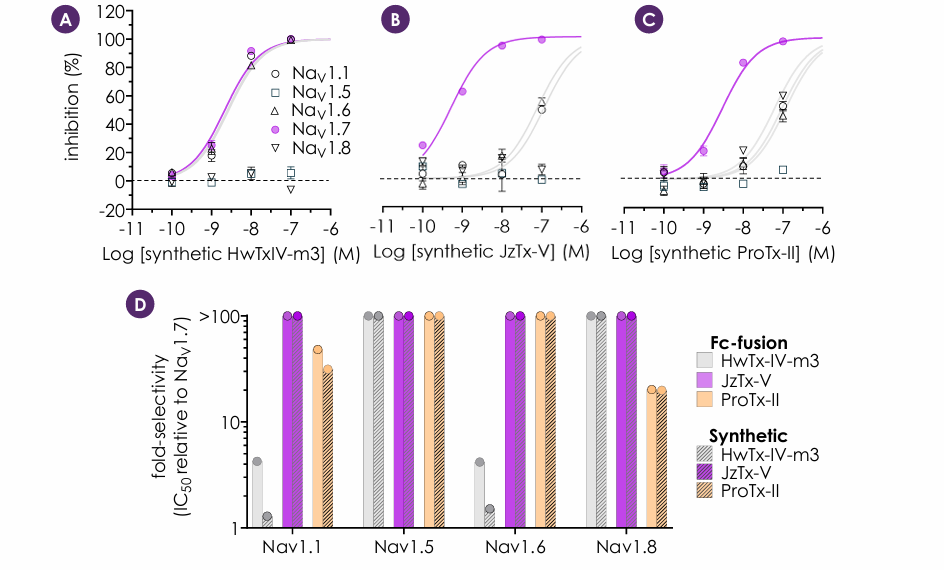
Selectivity profiles of three (commercially available) synthetic peptides were determined (A – C) and compared to the recombinant form. All Fc-toxin fusions demonstrated similar selectivity profiles (normalised to NaV1.7) to their synthetic counterpart, supporting the effectiveness of this strategy in producing viable peptides (D).
6. Effect of Fc-ProTx-II on neuronal function
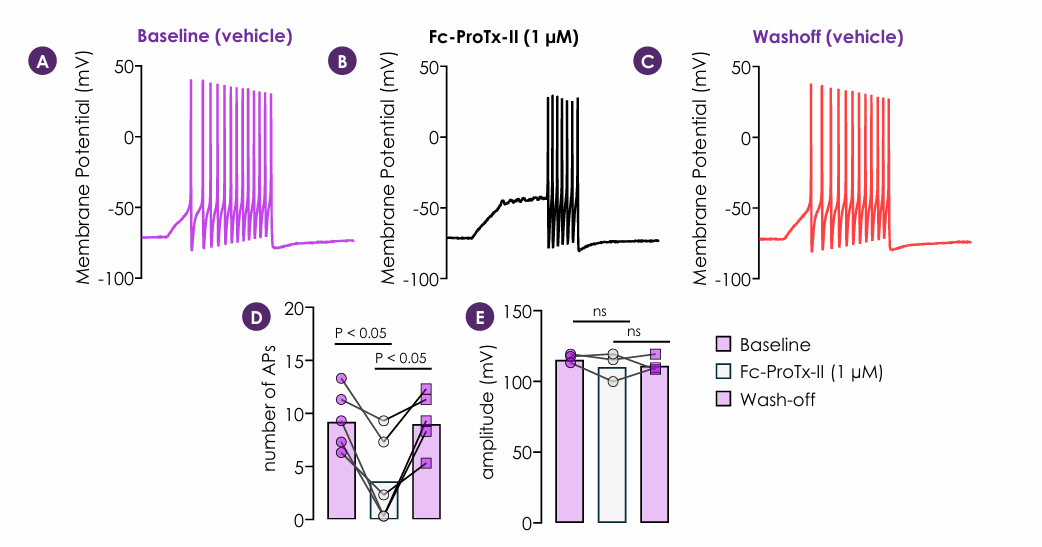
Fc-ProTx-II was selected for neuronal excitability studies due to high potency, selectivity and reproducibility. Fc-ProTx-II reduced action potential firing in rat dorsal root ganglion neurons, which was reversible upon washout (A – C). The number of action potentials occurring upon Fc-ProTx-II application was significantly reduced (D), whereas action potential amplitude, which is governed by other NaV channels, was unaffected (E), suggesting selective inhibition of NaV1.7.
Automated patch clamp enables robust NaV1.9 screening, accelerating discovery of selective sodium channel modulators for pain research.
The cardiac late Na+ current (late INa) generates persistent inward currents throughout the plateau phase of the ventricular action potential and is an important determinant of repolarisation rate, EADs and arrythmia risk¹. As inhibition of late INa can offset drug effects on hERG and other repolarising K⁺conductances, it is one of the key cardiac channels in the Comprehensive in vitro Pro-arrythmia Assay (CiPA) panel being developed by the FDA to improve human clinical arrythmia risk assessment²̛ ³.