written by Jacob Browne, University of Cambridge
 What and where are you currently studying?
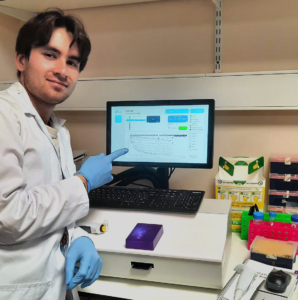
I’m a second-year MRC iCASE PhD student. I work across the University of Cambridge Department of Pharmacology under Dr Paul Miller, and with Metrion, to develop a BRET (Bioluminescence Resonance Energy Transfer) assay which will be used to identify modulators of Nav1.9.
NaV1.9 is a voltage gated sodium channel thought to be a potential target for inflammatory pain disorders, though it lacks any specific or potent ligands to validate this therapeutically. A BRET assay works by using a bioluminescent enzyme attached to one species to excite a fluorescent tag attached to a second. This interaction only occurs when the two are proximal, enabling the measurement of the affinity of potential modulators for the channel. We hypothesize that the assay’s sensitivity may make up for the channels’ poor expression, and its measurement of direct binding interactions will remove any reliance on the channels’ unorthodox kinetics. The project revolves around the development of various Nav constructs, fused with luciferase enzymes required for the BRET donor signal, and an array of fluorescent toxins to act as BRET acceptors.
My work at Metrion so far has involved the validation of NaV constructs using their automated patch clamp facilities and expertise, with their NaV1.9 CHO stable cell line acting as a reliable control. The large-scale experiments enable a more robust screening of transiently transfected channels than would otherwise be possible with smaller-scale experiments. We plan to eventually counter-screen any hits identified by the BRET assay using the same methods.
I also attended Metrion’s Academic Ion Channels Workshop earlier this year. This taught me a great deal about other electrophysiological methods; one I was particularly interested in being the manual patching of lysosomes (Figure 1).
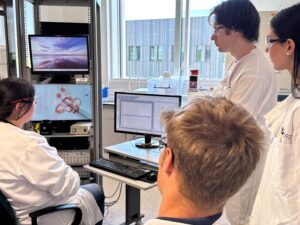
Figure 1: Manual patching of lysosomes during Metrion Academic Ion Channels Workshop 2025.
Firstly, just hearing the team talk about ion channels and electrophysiology was inspiring. The diversity of knowledge and experience is impressive, and it made me want to keep learning. Despite having mostly worked on ion channels for as long as I’ve been in research, I’ve somehow managed to avoid electrophysiology until now, and even just analysing patch clamp data with them taught me a great deal.
For as long as I remember I have been interested in nature- finding all sorts of sea creatures, plants and fungi on walks with my grandad. Science was easily my favourite lesson in school and was the only one that was able to address the never-ending series of questions I had about the world. I never considered science was a possible career for me and didn’t even know what a PhD was. Despite planning to do an apprenticeship after my GCSEs, my dad convinced me to do A-levels, where I found I really enjoyed biology and chemistry. I was surprised to find I was accepted onto a Chemistry degree, though I dropped out after a few weeks because I didn’t believe I was academic enough to complete the course.
I then spent some years working in hospitality and doing some labouring work for family. It wasn’t until I eventually decided to go back to university, this time studying pharmacology and drug discovery at the University of East Anglia, that I became confident in my passion for science. I was particularly inspired by Dr. Leanne Stokes while working with her on various projects. Her faith in me, as well as her enthusiasm for the topic, developed my love of science into a love of research.
I would certainly say there are a great deal of benefits. Primarily, being able to learn in a second lab that is run differently to your main lab is very useful, and provides a much more diverse experience, preparing you more for what comes next. The exposure to different people and ideas is always useful and can result in you learning much more than you otherwise would. The industry exposure itself is also useful, as many enter a PhD not knowing exactly what sort of research they want to do after (myself included).
The only other advice I would give other than ‘go for it’ is to investigate the company, perhaps look on LinkedIn and reach out to some employees to get an idea what it might be like there, and if it will be the right environment for you. I really enjoy being at Metrion and I think it is really important that everyone is able to find the right place for them as well.
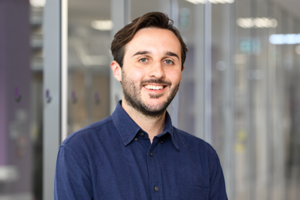 “It has been a pleasure to support Jacob through his MRC iCASE PhD project and to see his work develop at the interface of academic and industrial research. His curiosity and commitment to advancing novel assay technologies have been impressive, and we are proud to have played a part in his scientific journey. Collaborations like this are invaluable as they provide emerging researchers with hands-on experience, fresh perspectives, and the opportunity to apply innovative approaches to real-world ion channel research.”
Alex Haworth PhD, Senior Scientist
Metrion
written by Jacob Browne, University of Cambridge
What and where are you currently studying?I’m a second-year MRC iCASE PhD student. I work across the University of Cambridge Department of Pharmacology under Dr Paul Miller, and with Metrion, to develop a BRET (Bioluminescence Resonance Energy Transfer) assay which will be used to identify modulators of Nav1.9.
NaV1.9 is a voltage gated sodium channel thought to be a potential target for inflammatory pain disorders, though it lacks any specific or potent ligands to validate this therapeutically. A BRET assay works by using a bioluminescent enzyme attached to one species to excite a fluorescent tag attached to a second. This interaction only occurs when the two are proximal, enabling the measurement of the affinity of potential modulators for the channel. We hypothesize that the assay’s sensitivity may make up for the channels’ poor expression, and its measurement of direct binding interactions will remove any reliance on the channels’ unorthodox kinetics. The project revolves around the development of various Nav constructs, fused with luciferase enzymes required for the BRET donor signal, and an array of fluorescent toxins to act as BRET acceptors.
My work at Metrion so far has involved the validation of NaV constructs using their automated patch clamp facilities and expertise, with their NaV1.9 CHO stable cell line acting as a reliable control. The large-scale experiments enable a more robust screening of transiently transfected channels than would otherwise be possible with smaller-scale experiments. We plan to eventually counter-screen any hits identified by the BRET assay using the same methods.
I also attended Metrion’s Academic Ion Channels Workshop earlier this year. This taught me a great deal about other electrophysiological methods; one I was particularly interested in being the manual patching of lysosomes (Figure 1).
Figure 1: Manual patching of lysosomes during Metrion Academic Ion Channels Workshop 2025.
Firstly, just hearing the team talk about ion channels and electrophysiology was inspiring. The diversity of knowledge and experience is impressive, and it made me want to keep learning. Despite having mostly worked on ion channels for as long as I’ve been in research, I’ve somehow managed to avoid electrophysiology until now, and even just analysing patch clamp data with them taught me a great deal.
For as long as I remember I have been interested in nature- finding all sorts of sea creatures, plants and fungi on walks with my grandad. Science was easily my favourite lesson in school and was the only one that was able to address the never-ending series of questions I had about the world. I never considered science was a possible career for me and didn’t even know what a PhD was. Despite planning to do an apprenticeship after my GCSEs, my dad convinced me to do A-levels, where I found I really enjoyed biology and chemistry. I was surprised to find I was accepted onto a Chemistry degree, though I dropped out after a few weeks because I didn’t believe I was academic enough to complete the course.
I then spent some years working in hospitality and doing some labouring work for family. It wasn’t until I eventually decided to go back to university, this time studying pharmacology and drug discovery at the University of East Anglia, that I became confident in my passion for science. I was particularly inspired by Dr. Leanne Stokes while working with her on various projects. Her faith in me, as well as her enthusiasm for the topic, developed my love of science into a love of research.
I would certainly say there are a great deal of benefits. Primarily, being able to learn in a second lab that is run differently to your main lab is very useful, and provides a much more diverse experience, preparing you more for what comes next. The exposure to different people and ideas is always useful and can result in you learning much more than you otherwise would. The industry exposure itself is also useful, as many enter a PhD not knowing exactly what sort of research they want to do after (myself included).
The only other advice I would give other than ‘go for it’ is to investigate the company, perhaps look on LinkedIn and reach out to some employees to get an idea what it might be like there, and if it will be the right environment for you. I really enjoy being at Metrion and I think it is really important that everyone is able to find the right place for them as well.
“It has been a pleasure to support Jacob through his MRC iCASE PhD project and to see his work develop at the interface of academic and industrial research. His curiosity and commitment to advancing novel assay technologies have been impressive, and we are proud to have played a part in his scientific journey. Collaborations like this are invaluable as they provide emerging researchers with hands-on experience, fresh perspectives, and the opportunity to apply innovative approaches to real-world ion channel research.”
Alex Haworth PhD, Senior Scientist
Metrion
written by Jacob Browne, University of Cambridge
What and where are you currently studying?I’m a second-year MRC iCASE PhD student. I work across the University of Cambridge Department of Pharmacology under Dr Paul Miller, and with Metrion, to develop a BRET (Bioluminescence Resonance Energy Transfer) assay which will be used to identify modulators of Nav1.9.
NaV1.9 is a voltage gated sodium channel thought to be a potential target for inflammatory pain disorders, though it lacks any specific or potent ligands to validate this therapeutically. A BRET assay works by using a bioluminescent enzyme attached to one species to excite a fluorescent tag attached to a second. This interaction only occurs when the two are proximal, enabling the measurement of the affinity of potential modulators for the channel. We hypothesize that the assay’s sensitivity may make up for the channels’ poor expression, and its measurement of direct binding interactions will remove any reliance on the channels’ unorthodox kinetics. The project revolves around the development of various Nav constructs, fused with luciferase enzymes required for the BRET donor signal, and an array of fluorescent toxins to act as BRET acceptors.
My work at Metrion so far has involved the validation of NaV constructs using their automated patch clamp facilities and expertise, with their NaV1.9 CHO stable cell line acting as a reliable control. The large-scale experiments enable a more robust screening of transiently transfected channels than would otherwise be possible with smaller-scale experiments. We plan to eventually counter-screen any hits identified by the BRET assay using the same methods.
I also attended Metrion’s Academic Ion Channels Workshop earlier this year. This taught me a great deal about other electrophysiological methods; one I was particularly interested in being the manual patching of lysosomes (Figure 1).
Figure 1: Manual patching of lysosomes during Metrion Academic Ion Channels Workshop 2025.
Firstly, just hearing the team talk about ion channels and electrophysiology was inspiring. The diversity of knowledge and experience is impressive, and it made me want to keep learning. Despite having mostly worked on ion channels for as long as I’ve been in research, I’ve somehow managed to avoid electrophysiology until now, and even just analysing patch clamp data with them taught me a great deal.
For as long as I remember I have been interested in nature- finding all sorts of sea creatures, plants and fungi on walks with my grandad. Science was easily my favourite lesson in school and was the only one that was able to address the never-ending series of questions I had about the world. I never considered science was a possible career for me and didn’t even know what a PhD was. Despite planning to do an apprenticeship after my GCSEs, my dad convinced me to do A-levels, where I found I really enjoyed biology and chemistry. I was surprised to find I was accepted onto a Chemistry degree, though I dropped out after a few weeks because I didn’t believe I was academic enough to complete the course.
I then spent some years working in hospitality and doing some labouring work for family. It wasn’t until I eventually decided to go back to university, this time studying pharmacology and drug discovery at the University of East Anglia, that I became confident in my passion for science. I was particularly inspired by Dr. Leanne Stokes while working with her on various projects. Her faith in me, as well as her enthusiasm for the topic, developed my love of science into a love of research.
I would certainly say there are a great deal of benefits. Primarily, being able to learn in a second lab that is run differently to your main lab is very useful, and provides a much more diverse experience, preparing you more for what comes next. The exposure to different people and ideas is always useful and can result in you learning much more than you otherwise would. The industry exposure itself is also useful, as many enter a PhD not knowing exactly what sort of research they want to do after (myself included).
The only other advice I would give other than ‘go for it’ is to investigate the company, perhaps look on LinkedIn and reach out to some employees to get an idea what it might be like there, and if it will be the right environment for you. I really enjoy being at Metrion and I think it is really important that everyone is able to find the right place for them as well.
“It has been a pleasure to support Jacob through his MRC iCASE PhD project and to see his work develop at the interface of academic and industrial research. His curiosity and commitment to advancing novel assay technologies have been impressive, and we are proud to have played a part in his scientific journey. Collaborations like this are invaluable as they provide emerging researchers with hands-on experience, fresh perspectives, and the opportunity to apply innovative approaches to real-world ion channel research.”
Alex Haworth PhD, Senior Scientist
Metrion