Action Potential Waveform Analysis in Human IPSC-Cardiomyocytes Enables Mechanistic Assessment of Multichannel Cardiac Effects

Ray Boffey¹, Chris Richardson¹, Duncan Hannah¹, Marc Rogers², Robert Kirby², Ian Witton², Trevor Perrior¹
Contract Research Organisations (CROs) Domainex and Metrion have formed a collaborative drug discovery partnership to identify novel chemical hits against ion-channel targets. Key to this collaboration are Domainex’s experience in hit identification and Metrion Bioscience’s expertise in ion channel screening and pharmacology. Both partners bring their extensive knowledge of drug target screening.
The transient receptor potential cation channel A1 (TRPA1) is a voltage-dependent, non-selective cation channel that plays a crucial role in sensory processes, particularly in the detection of noxious stimuli such as irritants and chemicals. It is an established therapeutic target, as antagonists of TRPA1 may have significant utility in the treatment of pain, chronic cough, and other inflammatory conditions. Due to its involvement in mediating pain and inflammatory responses, TRPA1 has been a focus of drug development efforts aimed at alleviating various chronic conditions, including neuropathic pain, asthma, and irritable bowel syndrome. Bautista et al.¹ described TRPA1 as a ‘gatekeeper of chronic inflammatory disorders of the skin, airways, and gastrointestinal tract’, highlighting its importance in managing a broad spectrum of inflammatory disorders and making it a key target for therapeutic intervention.
As part of this collaboration, Domainex applied its proprietary LeadBuilder platform to identify commercial compounds for screening based on Metrion’s validated agonist and antagonist profiles of reference compounds. Compounds were then purchased and screened at Metrion through an extensive cascade of assays, to identify true antagonists of the TRPA1 ion channel, with the ultimate goal of advancing the development of novel therapeutic agents targeting this critical ion channel, which plays a pivotal role in various physiological processes, including pain sensation and inflammation.

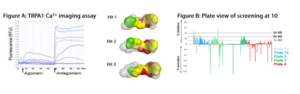
Figure 1. Results of the TRPA1 Ca2+ imaging assay and B: Plate view of TRPA1 agonists and antagonists.
Domainex has applied its LeadBuilder platform to the identification of antagonists for the therapeutically relevant voltage-dependent ion channel TRPA1.
The ligand-based study used Nuclear Magnetic Resonance (NMR) derived structural data and site-directed mutagenesis data as well as small molecule SAR.
Small molecule hits have been obtained from multiple chemotypes with micromolar potency. These include compounds with high similarity to the query molecules and also some more diverse structures. The compound structures are suitable for optimisation as part of a drug discovery project.
Metrion offers expertise in detailed pharmacological evaluation of ligands and this was used to underpin the ligand selection used for the virtual screen.
Action Potential Waveform Analysis in Human IPSC-Cardiomyocytes Enables Mechanistic Assessment of Multichannel Cardiac Effects
Cardiac toxicity remains the leading cause of new drug safety side-effects. Current preclinical cardiac safety assays rely on in vitro cell-based ion channel assays and ex vivo and in vivo animal models⁽¹⁾. These assays provide an indication of acute risk but they do not always predict the effect of chronic compound exposure, as recently seen with oncology drugs. Therefore, new assays are required to characterise chronic structural and functional effects in human cells earlier in drug discovery. Impedance-based technology can provide more accurate chronic cardiotoxicity measurements in an efficient manner using human induced pluripotent stem cell-derived cardiomyocytes (hiPSC-CMs).